Legal AI's two speeds: the agentic bet and the assistive present
Legal tech raised billions to build agents. Posts in practitioner forums still name ChatGPT more than every built-for-law tool combined. Koobo measures the gap.
The money has already decided that the future of legal AI is agentic. Legal-tech venture funding hit somewhere between $4 and $7 billion in 2025, depending on how it is counted, up from about $871 million in 2023 (Crunchbase, Artificial Lawyer, LexisNexis). Harvey, which sells an AI assistant to law firms for drafting, research, and review, went from a $5 million seed in 2022 to an $11 billion valuation in March 2026 on more than $1 billion raised. On the company's own reported figures, its ARR nearly doubled from $100 million in August 2025 to $190 million by January 2026; after it shifted to running agentic workflows, its monthly AI token use rose about 12x, from roughly 1 trillion to 12 trillion, in under six months. Harvey's CEO puts the thesis plainly: AI is "becoming the system through which legal work gets done."
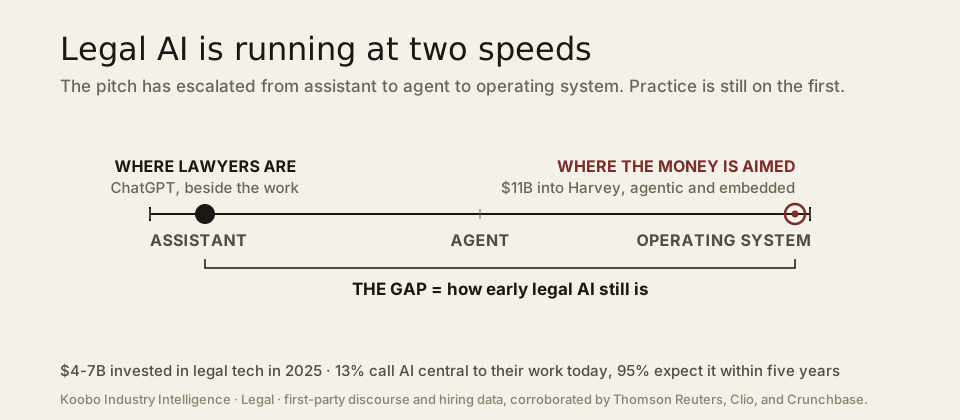
The record inside the profession is more improvised. What practitioners post about is a general-purpose chatbot in a browser tab, beside the work, handling information. Koobo's data measures the gap from both ends: what gets posted in practitioner forums, and what legal-tech companies are recruiting to build.
The record: general-purpose AI, beside the work
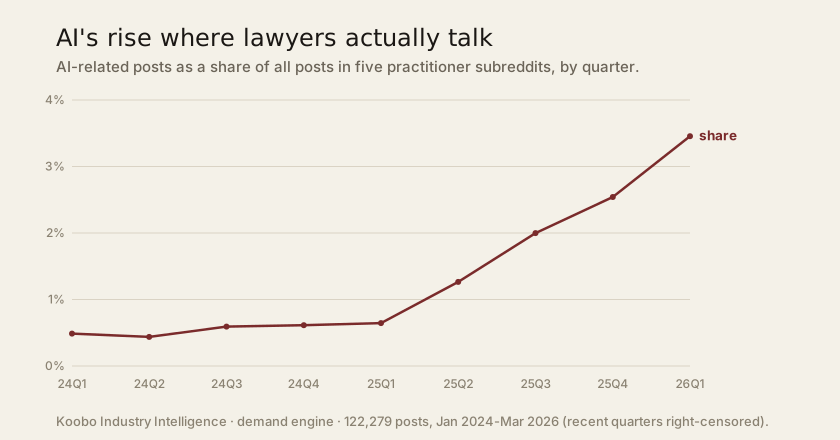
Koobo's discourse engine tracks five practitioner subreddits and counts posts. AI's share of all posts in them rose from 0.54% in the third quarter of 2024 to 5.39% in the second quarter of 2026, nearly tenfold, and the change is wide enough to survive a confidence test at both ends.
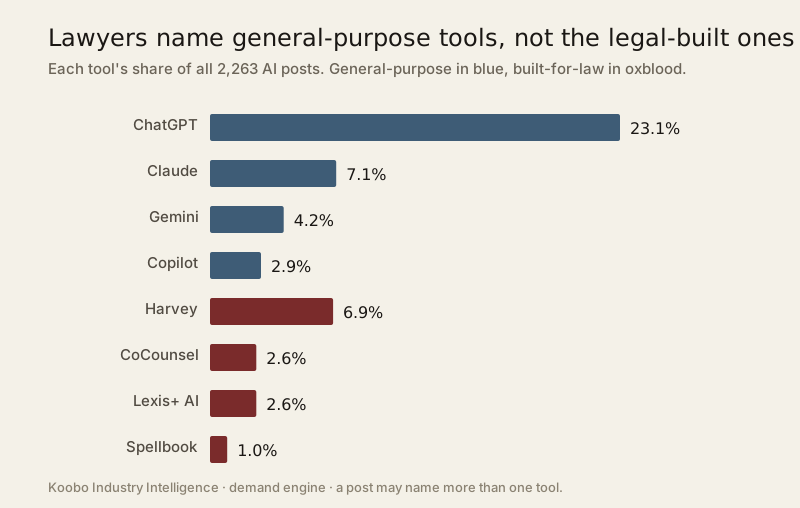
ChatGPT is named on 523 posts, against 339 for every built-for-law product combined. Those totals run wider than the charts, covering every AI post the engine holds for these five subreddits from January 2024 to July 2026. That is 2,263 posts, and 907 of them name a specific tool. All four general-purpose chatbots total 843 namings, about two and a half times the ten legal products combined. Harvey ranks third among all named tools.
Outside surveys ask rather than observe, and they land in the same place. Thomson Reuters found the most common applications among professionals already using generative AI are document review (74%), legal research (73%), and summarization (72%): information handling and first drafts, work that surrounds judgment rather than supplanting it.
Tool mentions exploded, and ChatGPT holds a smaller slice
Posts that name a specific tool went from 48 in the third quarter of 2024 to 215 in the second quarter of 2026, nearly four and a half times. ChatGPT's share of them fell from 73% to 47%, while its own count nearly tripled, from 35 to 101. Posts naming a tool but not ChatGPT grew faster still, from 13 to 114. Of the eight tools with a monthly series, two move enough to survive a confidence test: ChatGPT downward, and Claude upward from 5 mentions to 75. Harvey's rise, 5 to 43, does not clear that bar. The record shows a thinner slice of a much larger conversation, not fewer mentions.
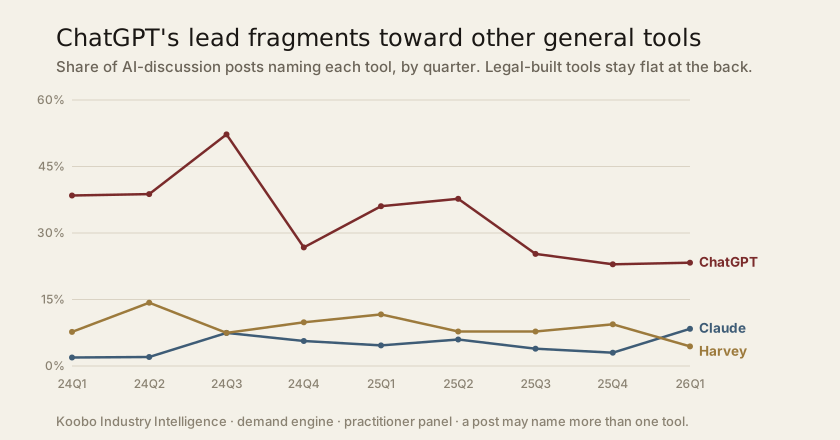
Two outside surveys point the same way. Clio's 2025 report found use of legal-specific AI fell from 58% to 40%, which it attributes to a shift toward general-purpose tools; Wolters Kluwer found 56% using general-purpose tools against 14% specialized. A browser tab is easy to swap, and the swapping has not settled.
The supply side is racing to close the gap
The companies building legal AI are recruiting to put it inside the work. Koobo's hiring analysis took a snapshot of 1,020 open roles across 14 legal-technology employers and counted the AI-build roles: those dedicated to building or deploying AI, not selling or supporting it. The AI-native vendors run about 1 in 5 open roles as AI-build, the older legaltech platforms about 1 in 18, and the two law firms about 1 in 28. Firms read as buyers, not builders.
AI-build work comes in two kinds. Research roles build the model itself: Research Scientist, AI Infrastructure Engineer. Deployment roles put that model into a firm's actual work, and the central one is the Legal Engineer, part lawyer and part deployment specialist, whose job is to make a model hold inside a legal workflow. The most common concept across these postings is "agentic", on 360 of them, against 79 that say "llm".
A Wayback-reconstructed history of eight of these employers dates the tilt: AI-build openings visible in 2024 are weighted to research, those in 2025 and 2026 to deployment. The reconstruction carries the direction and not the counts. The Legal Engineer title first appears in May 2025 at Wordsmith, then at Harvey, Filevine, and Legora.
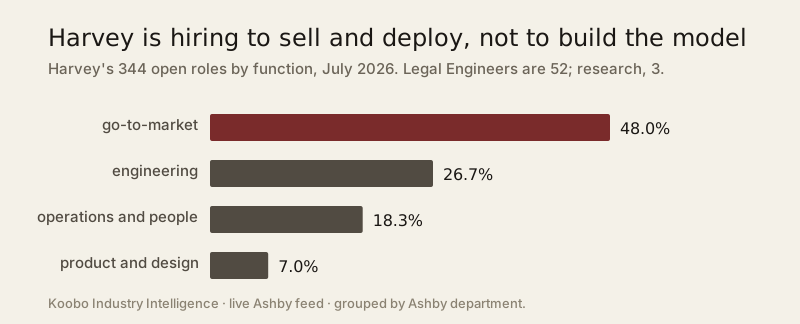
Harvey, the most-funded case, shows what that looks like up close. Its 333 postings in this dataset are 191 distinct job titles. Those titles lean commercial and deployment rather than model research: legal engineering accounts for 25 of them, and exactly one names model research, Research Engineer, Post-Training. Harvey says it serves more than 100,000 lawyers across more than 1,300 organizations, and that its A&O Shearman deployment has about 2,000 lawyers using it daily. Those are the company's own published figures, not ours.
The Legal Engineer is now a real profession, paying about $175K to $320K for JD-required roles, with standing teams at Harvey and Thomson Reuters. Legora, a competing vendor valued around $5.5 billion, published a piece in 2025 called "The rise of the Legal Engineer." It is the exact job that moves AI from beside the work to inside it.
What "early" actually looks like
That build-out does not mean adoption has caught up. The vendors are hiring ahead of where most legal work happens. Demand is general-purpose and assistive; supply is agentic and embedded. That gap is not a verdict on the specialized tools. It is what early looks like.
The topic mix says the same thing in a quieter way.
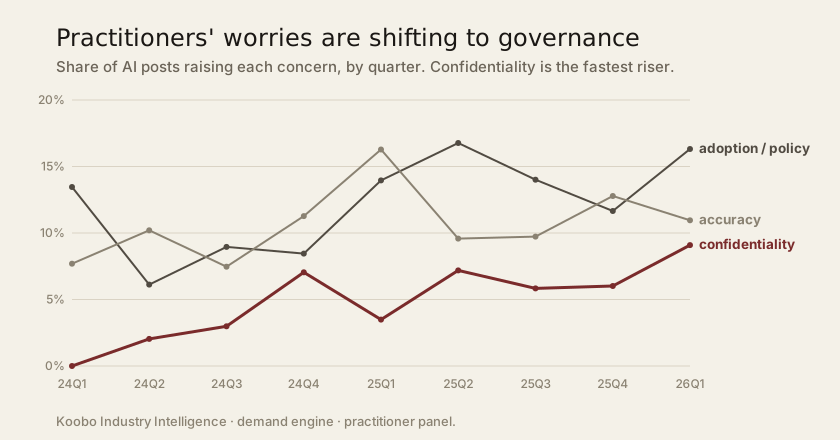
AI posts grew more than tenfold over the same quarters, from 67 to 718. The order did not move. Adoption and accuracy take the top two places in all eight quarters and swap only with each other; confidentiality and ethics hold the next two on the same terms; billing is last or level with last every time. Accuracy posts in the final quarter outnumber all AI posts in the first. On the sticking point, the surveys are less equivocal: the ABA reports accuracy and hallucination as the leading brake, cited by about 75% of those holding back.
This reads as a market at the front of the curve, not one deciding against AI. In Thomson Reuters' 2025 survey of about 1,700 legal, tax, accounting, risk and government professionals, 95% expect generative AI to be central to their organization's workflow within five years, against 13% who say it is today. That figure spans professions rather than isolating law; it is the runway the supply side is recruiting to fill.
The pitch keeps escalating: vendors have moved from selling an assistant to an agent to an operating system, and Harvey's CEO already calls AI the system that legal work runs through. What the posts describe is still an assistant in a browser tab. Whether that destination is real or not, the distance is not a better-model problem; it is a governance and workflow problem.
The record shows AI beside the work; the builders are racing to move it inside. Where your own firm sits between them is the number worth knowing.
That is where this series goes next, and Part 2, The legal AI conversation is splitting in two, is live now: it reads the comment layer under these same posts, codes every comment naming Harvey for adoption signal and sentiment, and finds the conversation splitting. In the one venue where the largest firms talk, the gap this essay measures is closing and the talk sounds like adoption; in the other four, no built-for-law tool is separating from the chatbots. Part 3 turns to the operating model that puts trusted AI inside the work.
To place yourself on that curve, the Legal AI Readiness Assessment scores where you sit across strategy, tooling, workflow, governance, and talent, and shows your weakest link.
A note on method
Everything here is an operations read based on aggregate public data. The demand signal counts posts across five practitioner subreddits as a share of all posts, so a busier community does not read as more AI interest. Every trend covers July 2024 to June 2026: the quarter before that has too small a base to carry a claim, and the newest month is held back because it undercounts. Three months are missing one subreddit's posts entirely, so their denominators are adjusted rather than left short, which would otherwise have inflated two of the highest points on the chart. Legal-tech and law-student boards are left out of this panel. Trend claims are tested at both ends with Wilson 95% intervals, and where those intervals overlap we say the series did not move.
The one figure that runs wider is the cumulative count of which tools get named: every AI post the engine holds for the same five subreddits, January 2024 to July 2026. The supply signal is a single-day snapshot of open roles at legal-technology employers; concept counts measure the language of the postings, not capability. The row-level job store covers 805 postings at 11 employers, a subset, so the 1,020-posting panel figures reconcile to the panel aggregate, not those rows.
Tool names are matched by keyword, which both misses namings and picks up words that are not the tool. About three in four of our Harvey matches are the product, and about half of our CoCounsel matches, so removing the wrong matches alone widens the gap this essay reports between general-purpose and built-for-law tools.
The historical piece, rebuilt from web archives, is coarse: we use it to read how the mix shifts, not to count roles. Role groupings come from keywords in the job title, the only field the dataset carries, and are taken over distinct titles rather than postings, because one role can be advertised in as many as nine cities. Every one of Harvey's 191 titles falls in a group. We use the outside surveys to check our own numbers, not to replace them, and they ask people, while we count posts.