The legal AI conversation is splitting in two
Harvey is gaining share of large-firm AI talk and almost nowhere else. Koobo coded 1,109 practitioner comments for the why: firm rollouts, praise for the document work, and a running argument over whether it beats a chatbot.
Part 1 ended on a gap: billions already funding one future for legal AI while practitioner posts describe another. Comments are where that gap gets argued, so this essay reads the 39,151 AI-mentioning comments beneath the same five practitioner subreddits, January 2024 through June 2026. They say the gap is closing in one place. In r/biglaw, the large-firm venue, Harvey's mention rate roughly tripled, from 41 to 123 per thousand AI-mentioning comments, and built-for-law tools rose from 24% to 44% of tool mentions. Across the other four subreddits that share reads lower, from 21% to 16%; the strictest count says that drop is too small to be sure of, and it is a drop in share rather than in count. Panel-wide the share is flat: 22% of tool mentions in 2024, 17% in 2025, 24% in the first half of 2026, differences too small to read as a trend.
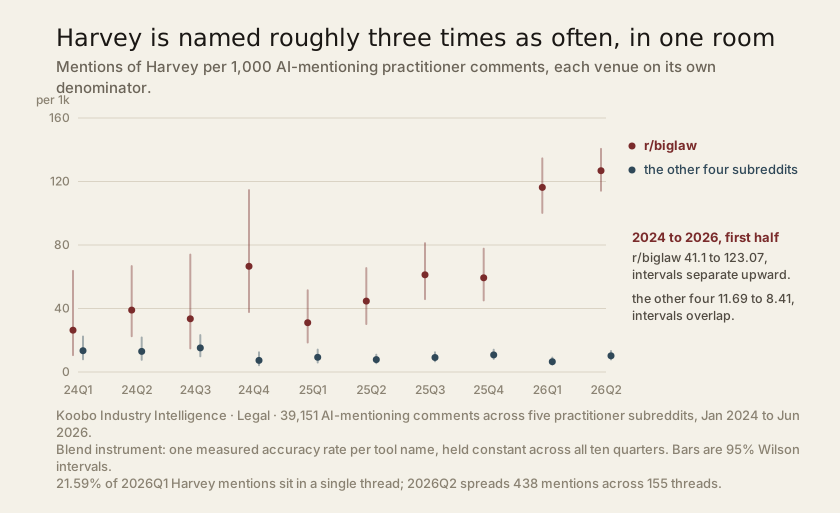
That rate moving in one venue is the observation. The insight comes from the why: why that venue and not the others, and what the people talking say the tool is for. So Koobo's discourse engine read the 1,109 comments in the record that name Harvey and coded each one for adoption signal, topic, and sentiment toward the product. The rest of this essay is what came back.
The surge describes use, not news
The easy hypothesis is budget: a new, expensive tool bought at firm level should surface first where large-firm employees talk. The coding is consistent with that and sharpens what the surge is made of. Of the 551 on-product Harvey comments in r/biglaw in the first half of 2026, 312 describe firsthand contact: the commenter's firm rolled the tool out, or they use it themselves, or a trial is underway. One in five describes a firm rollout outright, and those rollout reports sit in 62 distinct threads rather than one launch thread.
What faded is Harvey as news. Comments that know the tool only from headlines, funding rounds, or other people's reports fell from 14% of the venue's Harvey talk before 2026 to 5% in the first half of 2026. Career anxiety is not the engine either: what Harvey means for jobs turns up in 14% of the 2026 comments, well behind reports of what the tool does. Comments cannot prove a purchase, but they do show what the surge is made of: use reports, holding their majority as the venue's Harvey talk grew, while the news share fell.
Praised as a document tool, argued over as a purchase
The topic coding splits along sentiment. Comments that speak well of Harvey talk about tasks: drafting appears in 34% of the positive comments and document review in 23%, with summarization and diligence behind them. Comments that speak ill of it rarely mention those tasks, tagging drafting and document review under 6% of the time each; their named complaints cluster on the purchase. Whether the tool beats a general-purpose chatbot comes up in 28% of the negative comments, price in 16%, and hype and skepticism about the product's standing in 40%. The named debate in this record is over the premium: whether the document work is worth paying for when a general-purpose chatbot sits one browser tab away.
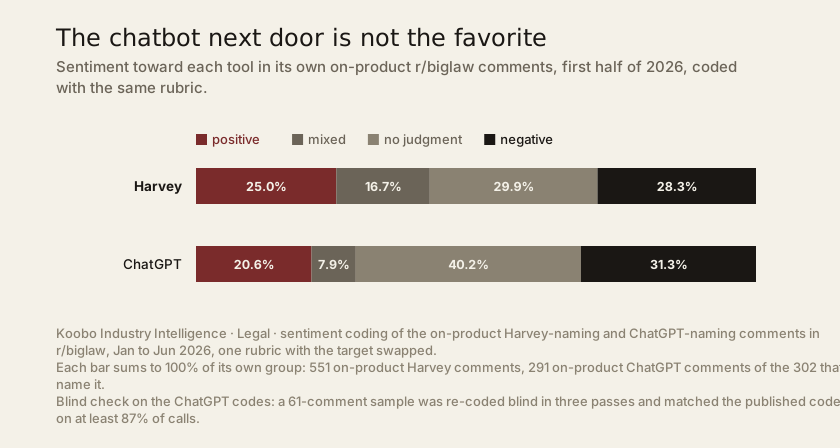
That tab is worth reading too. The engine coded the 302 comments naming ChatGPT in r/biglaw across the same six months with the same rubric, target swapped; 291 mean the product. The chatbot is not better liked. Its positive share reads 21% against Harvey's 25%, its negative share 31% against 28%, and both gaps sit inside the intervals.
What separates the two is judgment itself: 40% of the ChatGPT comments pass no product judgment, against 30% of the Harvey talk, and the carefully mixed read shows up less than half as often. The difference in this record is not affection. The chatbot is just more often named without a judgment attached.
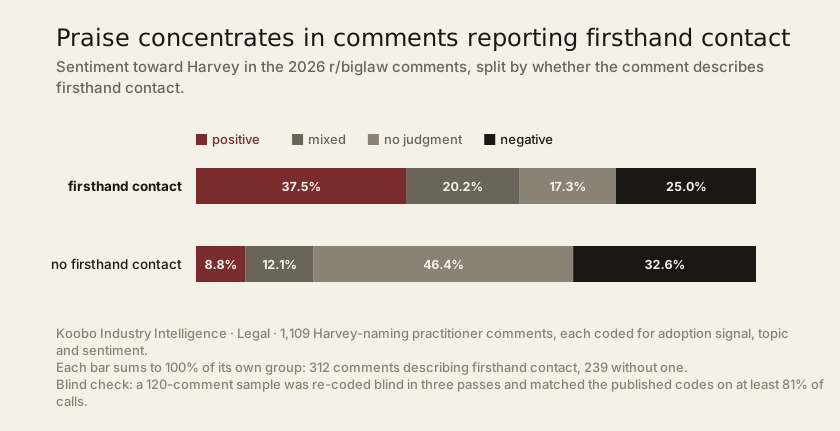
Sentiment splits on contact the same way. Among the 2026 r/biglaw comments describing firsthand use, 38% read positive; among the rest, 9%. Complaints run at a similar rate in both groups, 25% and 33%, and nearly half of the no-contact comments pass no product judgment at all. To check the codes, a sample was re-coded blind three times, and the published codes matched the majority on at least 81% of calls; under the corrected sample codes the positive gap narrows to roughly two to one and keeps its direction. Praise concentrates in the comments that report firsthand contact; the shrugs sit in those without one.
The other four rooms
Outside r/biglaw the record is thin, and the thin talk is not hostile. The four other venues held 89 on-product Harvey comments in the first half of 2026 against 551 inside it, roughly one outside for every six in. None of the four moved the way r/biglaw did: together they ran 12 per thousand comments in 2024 and 8 in the first half of 2026, a change too small to clear the interval test, and no single venue separates upward under any of the three readings. Those 89 comments read 37% positive against 19% negative, friendlier than r/biglaw itself, so what the record shows is low volume rather than a verdict. Cost is the obvious suspect, and price does come up in 17% of the non-biglaw comments, but the comments name the barrier without resolving it.
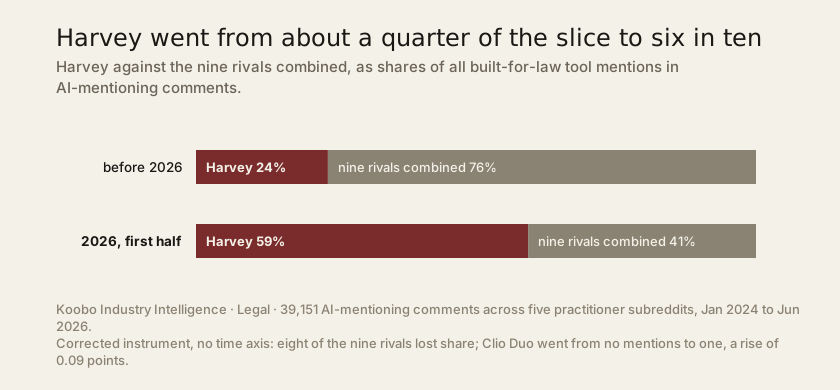
The category itself barely moved: general-purpose chatbots are named about four times as often as the ten built-for-law tools combined across the whole window, and the built-for-law share of tool mentions ends the window where it started panel-wide. What moved sits inside the slice: on a pooled cut, Harvey went from about a quarter of built-for-law mentions before 2026 to six in ten in the first half of 2026.
Take Harvey out of the count and the pooled rise disappears; take out any one of the nine rivals and it stands. Eight of the nine lost share even as most were named more often per quarter, and the ninth, Clio Duo, went from no mentions to one. One caveat keeps the venue claim honest: r/paralegal's built-for-law share rose too, from 12% to 21% on a small base, with no Harvey movement, so whatever is being named more often there is a different and smaller story.
What this means
Taken together, the coded record describes two conversations. In one, the talk sounds like adoption: document work praised, the premium argued over, the news cycle fading. In the other, covering four of the five venues here, no built-for-law name is separating from the pack and the default tool in the conversation is a general-purpose chatbot. The budget hypothesis maps the first conversation to enterprise procurement. The record is consistent with that reading without proving it, because comments show talk, not purchase orders. What the record does establish is narrower and firmer. The gap Part 1 measured between funding and practice is closing in the one venue where rollout talk lives, not evenly across the five.
The split carries different instructions for different readers, and the record can motivate them only as hypotheses, not findings. For a large firm weighing the category, the named complaints in this record cluster on the premium, not the document work. The place to press a vendor is the argued part: what the tool does that a general-purpose chatbot does not, at the price asked. The smaller firm reads it the other way: the traction evidence comes from the largest firms, and in its own venues no built-for-law tool is pulling ahead of the chatbots.
The TLDR: Harvey is gaining share of the talk, and only in the venue where the largest firms talk. Sentiment leans its way against the chatbot, though the margins are inconclusive. Praise concentrates in the comments that report firsthand contact. And the question the record leaves open is price: whether the document work is worth the premium.
The comment layer stops at the office door. Part 3 goes inside: the operating model, the governance, and the workflow that decide whether a tool that arrives on every desk earns a place in the work. To see where a firm stands now, the Legal AI Readiness Assessment scores it on strategy, tooling, workflow, governance, and talent, and names the weakest of the five.
A note on method
The record is the comment layer of the same five subreddits Part 1 read, aggregate public data throughout: 39,151 comments of 60 characters or more that mention AI, January 2024 through June 2026. Part 1 counted posts; this essay counts the comments underneath them, and numbers from the two layers are never set against each other. Within the record the engine counts mentions of 14 named tools, ten built for law and four general-purpose, with a list of excluded readings per name, so a Harvey Specter joke does not count for Harvey. A share here is a share of tool mentions: talk, not seats, contracts, or revenue.
Every mention-rate claim is read three ways: a strict gated count that understates, an ungated count that overstates, and a blend that applies one measured accuracy rate per name, 99% for Claude, 77% for Harvey, 71% for CoCounsel. The rates are held constant across all ten quarters, so no step can be built in at the 2026 boundary. Trend claims ship only where the readings agree and the 95% Wilson intervals at the two ends separate, and shares are computed within each venue on that venue's own comments, so a subreddit growing inside the corpus cannot manufacture a panel trend. The first 2026 quarter leans on a few large threads; the second, larger quarter spreads 438 mentions across 155 threads with the biggest holding 5%.
The coded findings rest on a second instrument: the 1,109 Harvey-naming comments, each coded for whether it means the product, the strongest adoption signal present, its topics, and its sentiment. The codes are aggregate-only, and no comment text is quoted. A 120-comment sample was re-coded blind in three separate passes; the published codes matched the majority verdict on 98% of the is-it-the-product calls, 84% of the firsthand calls and of sentiment read as polarity, and 81% of the full four-way sentiment codes. The record carries no author field, so a single prolific commenter cannot be ruled out; the thread spread is the nearest available check, not a substitute for one. The ChatGPT contrast rests on the same rubric with only the target swapped, applied to the 302 comments naming ChatGPT in r/biglaw over the first half of 2026. Its codes carry the same check: a 61-comment sample, re-coded blind in three passes, matched the published codes on 100% of the is-it-the-product calls, 98% of the firsthand calls, and 87% of the sentiment codes read either as polarity or as the full four-way code, and the disagreements lean toward no judgment, which strengthens the published contrast rather than weakening it. All of it measures naming in public forums: talk, at a real distance from procurement, and the same distance Part 1 measured one layer up.